

The gender gap in sports practice is reduced to historical lows
The Survey of Sports Habits 2024-2025 is now available
- The difference between men’s and women’s sports practice has been reduced in the last two years to 6.7 percentage points, according to the latest edition of the Survey of Sports Habits, prepared by the Ministry of Education, Vocational Training and Sports together with the Higher Sports Council (CSD).
- The study also reflects a new increase in the number of people who practice sport in Spain, which already reaches 62.7%, placing soft and intense gymnastics, hiking, muscle building, swimming and cycling as the most practiced modalities.
- For the president of the CSD, José Manuel Rodríguez Uribes, these data are the “visible proof” of the effort of the Government of Spain in “promoting sport and physical activity among the population, from the base to the elite”.
Madrid, January 29, 2026.- This Thursday a new edition of the Survey of Sports Habits has been published, the study carried out by the General Subdirectorate of Statistics and Studies of the Technical General Secretariat of the Ministry of Education, Vocational Training and Sports together with the Higher Council of Sports (CSD), included in the National Statistical Plan and which collects the main indicators relating to the sports habits and practices of the Spanish population during the last year.
Among the main data extracted from the study - carried out between October 2024 and October 2025 among a sample of population aged 15 and over -, the continuous increase of people who practice sports in our country stands out.
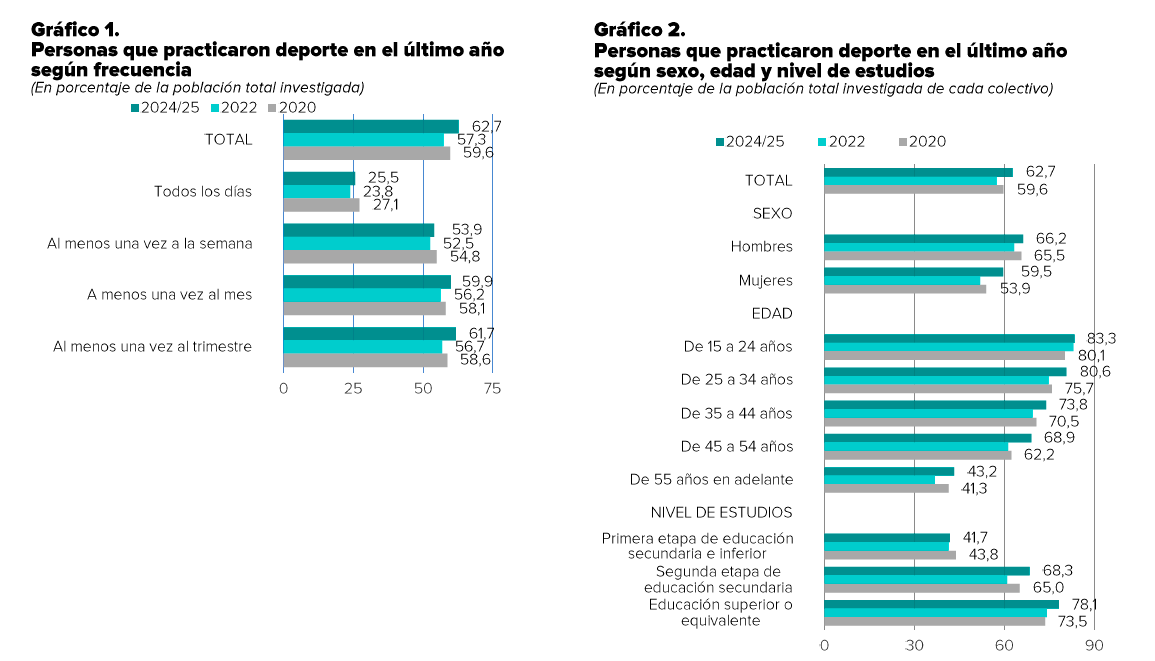
Specifically, 62.7% of the Spanish population practiced sport during the last year, either periodically, occasionally or both. This figure represents an increase of 5.4 percentage points compared to 2022, the last year analyzed.
In addition, most of those who claim to play sports tend to do so frequently: 25.5% daily, 53.9% at least once a week and six out of ten respondents at least once a month.
For the president of the CSD, José Manuel Rodríguez Uribes, the increase in sports practice in our country in recent years is “a visible and tangible proof of the effort of the Government of Spain in promoting sport and physical activity among the entire population, from the base to the elite, as State policy and as an important health engine”.
Another noteworthy fact in the study is the significant reduction of the gender gap in sports practice. Although men still present figures higher than those of women - 66.2% compared to 59.5% - the difference has continued to decrease noticeably in recent years, reaching the historical minimum of 6.7 percentage points, almost half that in 2022, when it stood at 11.3 points.
“These data show that equality in sport is not a slogan or a claim: it is our goal, and we are approaching it thanks to a new and ambitious Sports Law, specific programs to promote women’s sports, awareness campaigns and aid to sports federations and organizations,” says Rodríguez Uribes.
For the president of the CSD it is “essential to continue working on these lines of action to be able to see in the next edition of this study that we have reached full balance”.
In addition to sex, age and level of education are also conditioning in sports practice rates.
In this way, annual participation rates exceed 83% among the youngest population and fall with age to around 43% in the 55-year-old age group. In comparison with 2022 and 2020, there are increases in all age groups.
By level of training, the highest rates of sports practice are observed among those with higher education -78.1%-, followed by those who have completed the second stage of secondary education -68.3%-, while the lowest rates are recorded among those with a lower education -41.7%.
The most practiced modalities
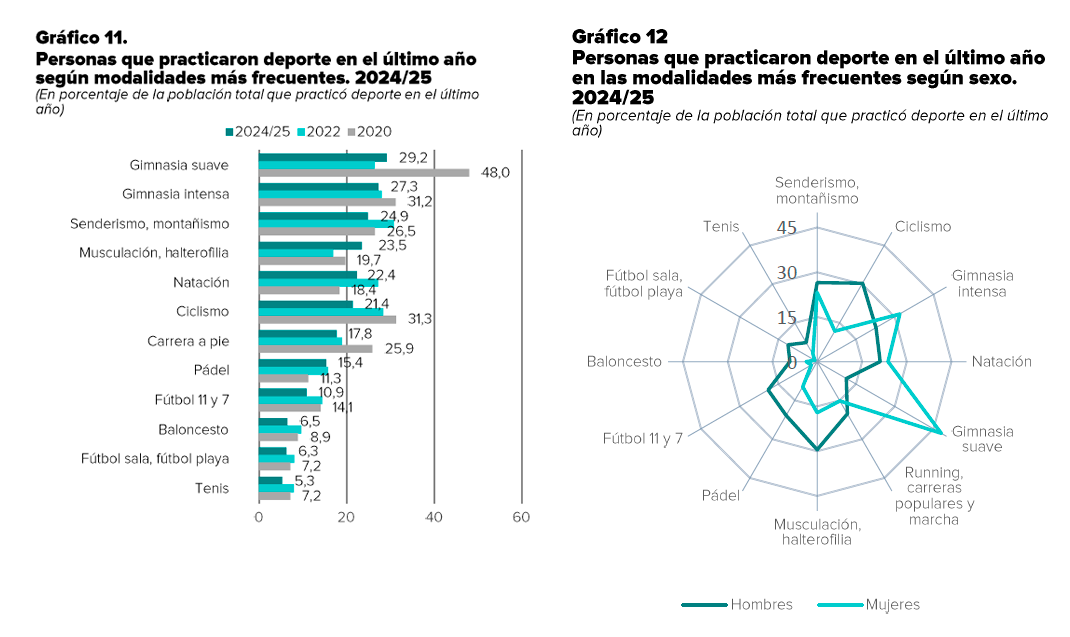
The most practiced modalities during the past year among those who practiced were mild gymnastics (29.2%), intense gymnastics (27.3%), hiking and mountaineering (24.9%), musculation and weightlifting (23.5%), swimming (22.4%), cycling (21.4%) and walking (17.8%). Among men the practice of cycling, soccer, musculation and weightlifting, hiking and mountaineering, intense gymnastics and swimming is much more frequent, while in women soft gymnastics, intense gymnastics, swimming and hiking and mountaineering dominate.
However, almost 3 out of 4 respondents say they practice more than one sport, especially among the youngest population.
Likewise, the preference for the practice of individual modalities continues to gain weight, standing at 63.6% of the population analyzed, compared to 11.5% who favored team sports.
Because of its importance, the Survey of Sports Habits separately investigates the practice of walking or walking, more or less quickly, at least ten minutes in a row and with a sporting purpose. An activity that, according to the study, carries out 78.7% of the population, which means an increase of 6.6 percentage points compared to 2022.
Contrary to general sports practice rates, the habit of walking or walking is more frequent in women (81.7% compared to 75.5% in men) and increases the older the age of the respondents up to 74 years.
In light of all these data, almost 73% of the Spanish population over 15 years of age complies with the recommendations of the World Health Organization (WHO) on physical activity, dedicating at least between 150 and 300 minutes of weekly moderate intensity physical activity (walking or cycling) or between 75 and 150 minutes of vigorous physical activity (sports practice as such) or a combination of both, a percentage that borders 80% among the population between 25 and 34 years of age.
Motivations and obstacles for sports practice
Being fit (28.8%) remains the main reason expressed by respondents to play sports, followed by relaxation (18.9%), health (17.1%) and fun (16.9%).
On the contrary, among the main barriers are lack of time (26.3%), lack of interest (11.9%), age (11.7%), practicing enough sport (11.4%) and family responsibilities (11.3%).
In terms of the age at which sport began, 59.4% of the population who practised sport began this activity before the age of 15; 20.5% did so between the ages of 15 and 24; 12.6% between the ages of 25 and 44 and only 7.5% began to do sport at the age of 44. The sex factor is decisive in this: 7 out of 10 men started before the age of 15, compared to 47.7% of women.
Parental involvement is also a decisive factor. Among those who play sports, 36.7% say that at least one of their parents practices or has practiced this activity. A figure that amounts to more than 74% among young people between 15 and 19 years old and that drops to 8.4% among people over 75 years old.
Regarding links with sports federations or entities, 10.0% of the population investigated has at least one sports license in force, tripling the percentage of men (15.0%) compared to that of women (5.1%). The highest values are observed among the youngest, reaching almost 20% among the group of 15 to 24 years.
Likewise, one third of the people investigated are subscribers or members of gyms, with the percentage of women being slightly higher than that of men.
In addition, practically the majority of the population in Spain has sports equipment at home, 83.6%. Among the most frequent are bicycles, exercise and muscle equipment, balls, rackets, mountain equipment and chessboards.
Attendance at events and access to sports information
75.2% of the reference population attended, at least once a year, a sports show, either in person or through audiovisual media, which also represents an increase compared to 2022. Specifically, 32.4% of the investigated population attended in person, while 72.8% did so through the media or the Internet.
Again, there are clear differences by sex: while the percentage of men who attended sports events - in person or through audiovisual media - is 84.0%, the percentage of women remains at 66.9%, data practically identical to those of the previous edition of the study.
In terms of the face-to-face shows, almost a third of the respondents attended those related to team sports, such as football and basketball, and only 6.6% with individual sports. Likewise, 83.1% of the face-to-face attendees to this type of event stated that they attended a show of masculine category, while only 24.5% did so of feminine category and 16.1% of mixed category.
There are also clear differences by sex in access to sports shows by audiovisual means: while the percentage of men who saw an event of this type reaches 82.4%, the percentage of women remains at 63.7%, despite the fact that the gap has narrowed in this edition. Similarly, of the people investigated who accessed sports shows through audiovisual media, 91.8% did so at male events, 42.4% at the female level and 19% at the mixed level.
For its part, the consultation of sports information continues to be a much higher practice among men -65%- than among women -34.4%. Television (90.3%) is still the most used medium, followed by the Internet (77.8%), mobile (75.6%), general press (74.0%), sports press (61.4%), social networks (58.7%) and radio (58.0%).
The highest values in the use of the internet as a sports information channel are recorded in the youngest population (from 15 to 19 years), reaching 96.9%, a figure that decreases as age increases, reaching less than 30% in the population of 75 years and older.
- Link to the Sports Habits Survey 2024-2025: https://www.educacionfpydeportes.gob.es/mc/deportedata/habitos/resultados.html