

Rodríguez Uribes: “Commemorating the International Day against LGBTIophobia is not a symbolic gesture, but an ethical responsibility”
The CSD and Onda Cero commemorate February 19 with the recording of a special program
- The president of the Higher Sports Council (CSD), José Manuel Rodríguez Uribes, participated this Thursday in a special program of Onda Cero on the occasion of the International Day against LGTBIphobia in Sport.
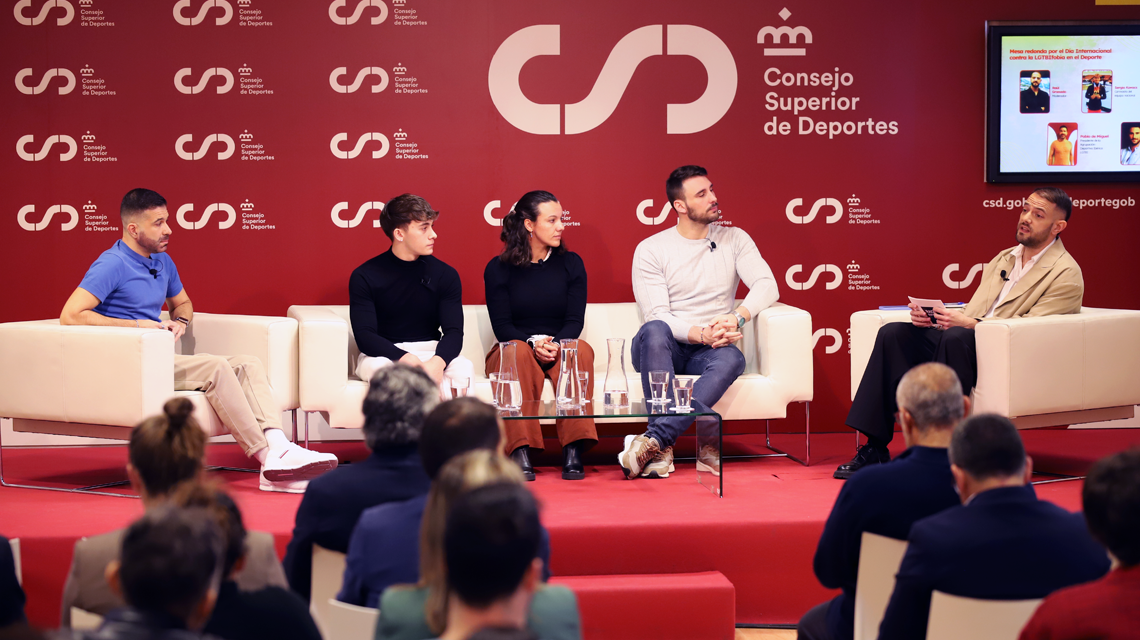
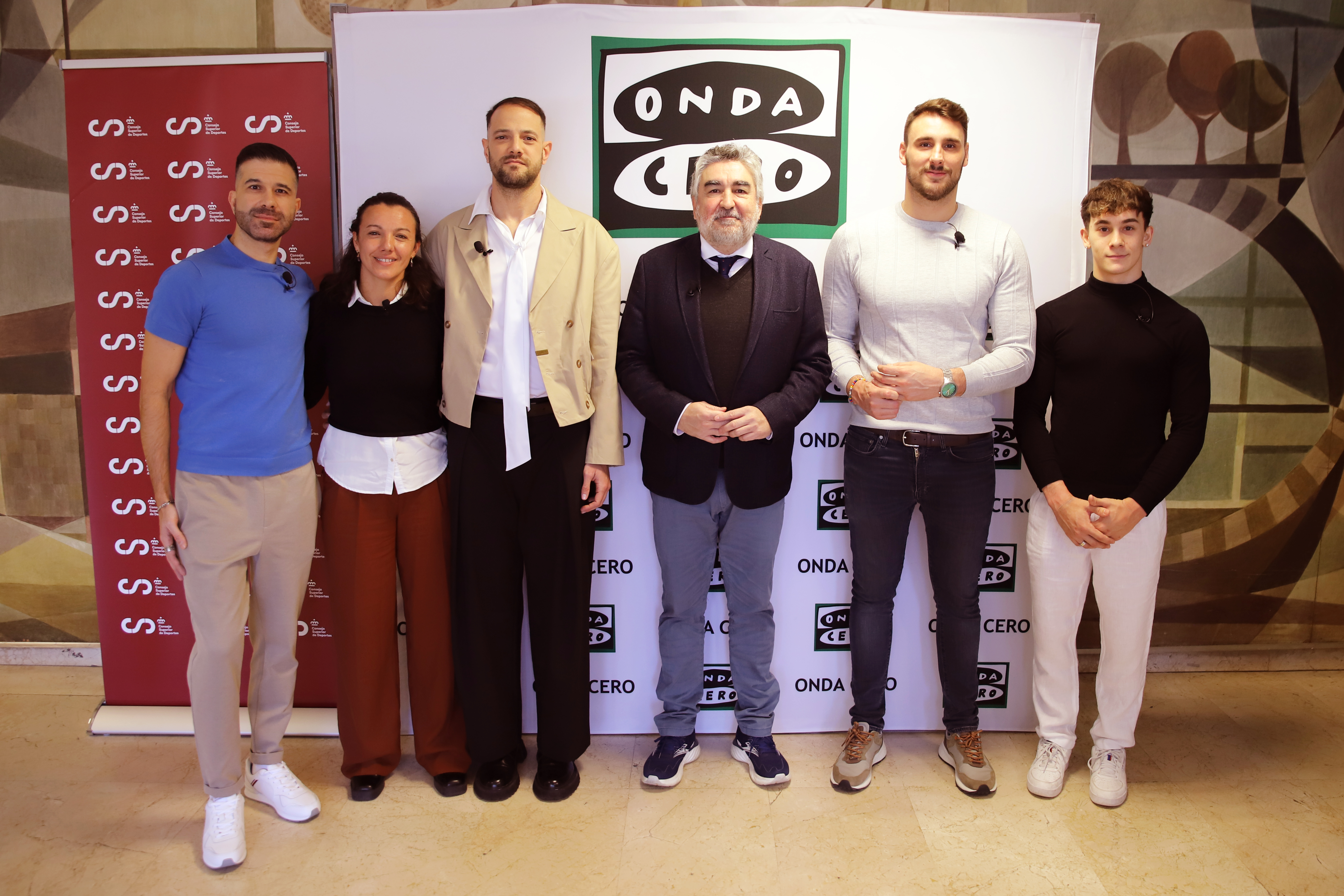
- Directed by journalist Raúl Granado, the program has also counted on the participation of gymnast Sergio Kovacs, waterpolist Víctor Gutiérrez, former soccer player Anair Lomba and the president of the Iberian Sports Group LGTBI+, Pablo de Miguel.
Madrid, February 19, 2026.- The Superior Sports Council (CSD) and Onda Cero commemorated this Thursday the International Day against LGTBIphobia in Sport with the recording of a special program that has allowed to analyze the trajectory, current situation and future challenges of LGTBI people in the different spheres of sport.
The program was presented by the journalist Raúl Granado and included the participation of the gymnast Sergio Kovacs, the waterpolist and national deputy Víctor Gutiérrez, the former soccer player Anaïr Lomba -current marketing coordinator in the French League and the president of the Iberian Sports Group LGTBI+, Pablo de Miguel, as well as an institutional statement by the president of the CSD, José Manuel Rodríguez Uribes.
At the start of this program, the president of the CSD has stressed the importance of visibility as a tool for social transformation.
“Visibility can save lives,” said Rodriguez Uribes, recalling that International Day Against LGTBIphobia in Sport is celebrated every February 19 in memory of Justin Fashanu, the first professional footballer to speak openly about his homosexuality in 1990 and who, after years of harassment and homophobic violence, took his life in 1998.
“Commemorating the International Day against LGTBIphobia is not a symbolic gesture, but an ethical responsibility,” said Rodríguez Uribes.
The Secretary of State for Sport has acknowledged that, although Spain is one of the most advanced countries in the European Union in terms of LGBTI rights, the sports field still presents relevant challenges.
“Two out of three LGBTI people have experienced some kind of LGBTIphobia in the sport. These data are not cold statistics: they are personal stories, they are truncated vocations, they are young people who stop finding in sport an area of freedom”, he reflected.
In this sense, the president of the CSD has been forceful: “That, Spanish society, cannot afford it. What’s more, we’re not going to allow it.”
A pioneering regulatory framework
The president of the CSD has also highlighted the adoption of the Sports Law in 2022 as a historic milestone by incorporating, for the first time, the equality of LGTBI people in the sports field and expressly sanctioning discrimination based on sexual orientation and gender identity, being one of the most advanced regulatory frameworks in Europe.
In this regard, Rodríguez Uribes has insisted that the rule must be accompanied by educational measures and institutional commitment: “A law alone does not change reality. It must be accompanied by education, institutional responsibility and collective commitment.”
Among the actions promoted by the CSD, Rodríguez Uribes recalled the campaign “Equals in Sport”, the participation for the first time in 2025 in the state march of LGTBI Pride under the motto “Sport with Pride”, the creation of a specific working group and the leadership of Spain, through the CSD, in the fight against hate speeches within the European Commission. “We want to turn around the amplification of hatred in social networks and make the messages of respect what is amplified,” he added.
Referents and allies: keys to change
In his speech, Rodríguez Uribes highlighted the role of referents and allies in the transformation of sport. Thus, he has highlighted the courage of Víctor Gutiérrez, whose denunciation after receiving insults in a waterpolo competition resulted in the first sanction for homophobia in Spanish sport. This demonstrated, in the words of the president of the CSD, that “denouncing serves, that institutions respond and that impunity is not going to be the norm.”
Rodríguez Uribes has also stressed the importance of having figures such as Sergio Kovacs and Anair Lomba and has highlighted the role of civil society, represented in this special program, organized by Onda Cero, by Pablo de Miguel and the Iberian Sports Group LGTBI+.
“Sport has an extraordinary symbolic strength. When an insult is chanted in a stadium, the damage is profound. But when a fans respond by painting their nails in solidarity with a player attacked for supporting diversity, the message is equally powerful. Respect also spreads,” he said.
The Chair of the CSD concluded by reiterating the agency’s firm commitment to equality and inclusion: “We cannot allow any young people to leave the sport out of fear. We cannot accept that the insult is normalized as part of the show. We cannot resign ourselves to invisibility being the survival strategy.”
“That is why, on behalf of the Higher Sports Council, I reiterate today our firm, unequivocal and permanent commitment to equality and inclusion. Because sport is not only about respect. It is also dignity. LGTBIphobia has no place in Spanish sport,” he said.
The program has continued with a colloquium moderated by Raúl Granado, in which Sergio Kovacs, Anaïr Lomba and Víctor Gutiérrez have been able to explain their personal experiences and analyze, together with Pablo de Miguel, the evolution and the future perspective for LGTBI people in sport.
During the debate, the speakers agreed on the importance of generating visible references in all sports disciplines and categories, as well as strengthening institutional support so that equality does not depend solely on individual courage.
In addition, they have noted the need to effectively apply the Sports Law to ensure safe environments from the ground up to high competition.
In short, the programme has shown that the visibility, institutional commitment and active involvement of clubs, federations and public administrations are essential elements to consolidate the progress achieved and ensure that sport is, in a real and effective way, an area of freedom, respect and dignity for all people.
- Images for editorial use available in: https://flic.kr/s/aHBqjCKW6i